Posts

Showing posts with the label Berlin

FOSS Backstage 2022 — A True Community Conference
Image
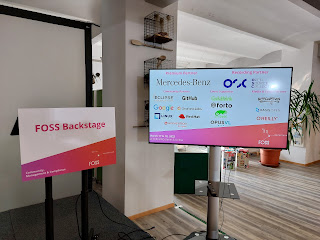
Attending the FOSS Backstage 2022 conference on "Community, Management & Compliance In Open Source Development" was a real highlight for me: A conference About Open Source In Berlin In person! I fondly remember the first edition in 2018 ( YouTube Archive , Flickr Photo Archive ) which actually helped with my Open Source work at DB Systel . Given the ongoing COVID pandemic, the conference was very small, with only about 60 people attending in person and 200 additional remote participants. That, and the conference location in a co-working space, gave the event a very intimate and personal feeling. More like a true community meet-up than a polished commercial event. The 2022 edition put the major focus on major Open Source related initiatives and community topics, but it didn't talk much about the practical sides of Open Source compliance, e.g. the OpenChain Project . I spoke with the organisers about that, and they indicated that future F...

micrxchg 2018: Serverless and Containers

Image
The 2 days of " The Microservices Conference in Berlin - 2018 " where packed with talks that clearly demonstrate that the world of micro services is based mainly on two topics: Serverless computing and containers. Users either go to the public cloud providers and use the existing frameworks there, e.g. Lambda, API Gateway, DynamoDB etc. on AWS , or users build their own platforms on top of Kubernetes (or a Kubernetes variant). The videos are available on the microXchg YouTube channel , my own talks: The slides for my own talks are available via SlideShare: Root for all - measuring DevOps adoption - microxchg 2018 - Schlomo Schapiro , see also Root for All - A DevOps Measure? blog article Kubernetes - Shifting the mindset from servers to containers - microxchg 2018 - Schlomo Schapiro , see also  Using Kubernetes with Multiple Containers for Initialization and Maintenance  blog article.

CoreOS Fest 2016 - Container are production ready!

Image
The CoreOS Fest 2016 in Berlin impressed me very much: A small Open Source company organizes a 2 day conference around their Open Source tools and even flies in a lot of their employees from San Francisco. A win both for Open Source and for Berlin. And CoreOS also announced that they got new funding of $28M : Alex Polvi , CEO of CoreOS More interesting for IT people everywhere is the message one can learn here: Container technologies are ready for production. There is a healthy environment of Open Source solutions: Kubernetes , Mesosphere DC/OS , containerd , even OpenStack and others. Commercial editions with vendor support like Tectonic  (CoreOS), Mesosphere Enterprise or Hashicorp Atlas 3rd party tools solving common problems like persistent storage: StorageOS  and  Quobyte In fact, choosing the "right" platform starts to become the main problem for those who still run on traditional Virtualization platforms. On the other hand, IT companies who don't ...

OSDC 2016 - Hybrid Cloud

Image
The Open Source Data Center Conference 2016 is a good measure for how the industry changes. Compared to 2014 Cloud topics take more and more space. Both how to build your own on-premise cloud with Mesos , CoreOS or Kubernetes but also how to use the public Cloud. Maybe not surprising, I used the conference to present my own findings from 2 years of Cloud migration at ImmobilienScout24 : After we first tried to find  way to quickly migrate our data centers into the Cloud we now see that a hybrid approach works better. Data center and cloud are both valued platforms and we will optimize the costs between them. Hybrid Cloud - A Cloud Migration Strategy Do you use Cloud? Why? What about the 15 year legacy of your data center? How many Enterprise vendors tried to sell you their "Hybrid Cloud" solution? What actually is a Hybrid Cloud? Cloud computing is not just a new way of running servers or Docker containers. The interesting part of any Cloud offering are mana...

Go Faster - DevOps & Microservices

Image
At the microXchg 2016 last week Fred George - who takes pride having been called a hand grenade - gave a very inspiring talk about how all the things that we do right now have one primary goal: Go Faster Reducing cycle time for deployments, automation everywhere, down-sizing services to "microservices", building resilient and fault-tolerant platforms and more are all facets of a bigger journey: Provide value faster and find out faster what works and what not. DevOps DevOps is seen by most developers as beeing an Ops movement to catch on with developers before their jobs become obsolete. Attending various DevOps Days in Germany and the USA, the developers who where also there always complained about the lack of developers and the lack of developer topics. They observed that the conference seems to be by and for Ops people. Consequently, DevOps conferences usually have two tracks: Methods and Tools. Methods teach us how to do "proper" software develop...

Cloud Migration ≈ Microservices Migration

Image
Day two at the microXchg 2016 conference. After listening to yet another talk detailing the pitfalls and dangers of "doing it wrong" I see more and more similarities between the Cloud migration at ImmobilienScout24 and the microservices journey that most speakers present. The Cloud migration moves us from a large data center into many smaller AWS accounts. A (legacy) monolithic application is cut into many smaller microservices. Internal data center communication becomes exposed communication between different AWS accounts and VPCs. Internal function calls are replaced with remote API calls. Both require much more attention to security, necessitate an authentication framework and add significant latency to the platform. A failed data center takes down the entire platform while a failed AWS account will only take down some function. An uncaught exception will crash the entire monolith while a crashed microservice will leave the others running undisturbed. Interna...

AWS Account Right-Sizing

Image
Today I was attending the Microxchg 2016 conference in Berlin. I suddenly realized that going to the cloud allows to ask completely new questions that are impossible to ask in the data center. One such question is this: What is the optimum size for a data center?  Microservices are all about downsizing - and in the cloud we can and should downsize the data center! In the world of physical data centers the question is usually goverened by two factors: Ensuring service availability by having at least two  physical data centers. Packing as much hardware into as little space as possible to keep the costs in check. As long as we are smaller than the average Internet giant there is no point to ask about the optimum size. The tooling which we build has to be designed for both large data centers and for having more than one. But in the "1, 2, many" series "2" is just the worst place to be. It entails all the disadvantages of "more than 1" without any o...

DevOps Berlin Meetup 2015-07

Image
Is Amazon good for DevOps? Maybe yes, maybe no. But for sure the new Berlin office is good for a Berlin DevOps Meetup . Jonathan Weiss gave a short overview over the engineering departments found here: AWS OpsWorks, AWS Solution Architects, Amazon EC2, Machine Learning. Michael Ducy (Global Partner Evangelist at Chef Software ) talks about DevOps and tells the usual story. Michael uses goats and silos as a metaphor and builds his talk from the famous goat and silo problem . He sees the "IT manufacturing process" as silos (read  History of Silos  for more about that) and DevOps minded people as goats: Multi-purpose, versatile, smart and stubborn at reaching their goals. The attendees of the DevOps event probably did not need much convincing, but the talk was nevertheless very entertaining. Michael has an MBA and also gave some useful insights into how organisations evolve into silos and how organisational "kingdoms" develop. The talk is available as video...

Meetup Marathon

Image
This week was my Meetup Marathon: Microservices Meetup Berlin about  Software Memories and Simulated Machines by  William Louth . Berlin DevOps about Scaling Logstash: A Collection of War Stories  by  Pere Urbon-Bayes and "Continuous development with Nix" by  Rok Garbas . Sadly there was no time for the traditional fish bowl discussion. AWS User Group Meetup about  STUPS tools & components platform by Henning Jacobs and Distributed Log Refinement Discussion  by  Christian Kniep . Software Memories and Simulated Machines was above my head. Scaling Logstash made me wonder how many engineers you actually need to run that "properly". Nix is something we hopefully don't need, Rok actually said that if you package everything you don't need it. STUPS  is the "Cloud Ops" stack from Zalando , nicely published on GitHub : The STUPS platform is a set of tools and components to provide a convenient and audit-compliant Platform-...

OpenTechSummit 2015

Image
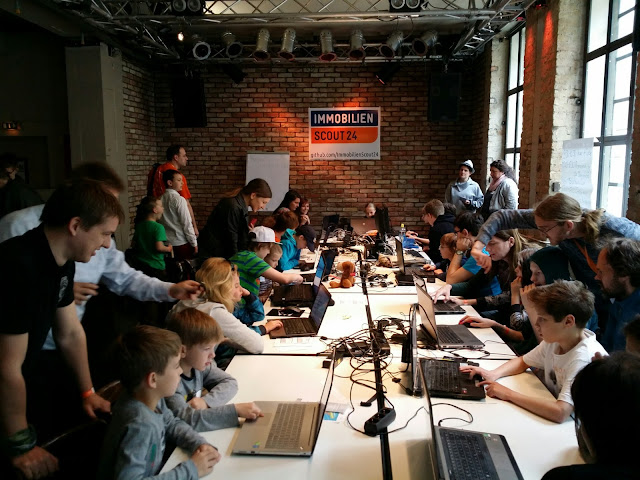
Yesterday was the first OpenTechSummit in Berlin, a new conference that came partially in place of the LinuxTag . The conference squeezed a large amount of talks into a single day. The talks where either 10 or 20 minutes long and covered many non-technical topics related to open knowledge or open technology. One thing impressed me especially: All day long there where workshops for children and youth. While some kids took their first steps in coding, others came to work together on advanced programming or hardware projects. The date (a German state holiday) made sure that children had time to attend, many IT people came together with their children. The organizers where actually surprised by the large amount of children who registered for a free kids ticket. I gave my " DevOps, Agile and Open Source at ImmobilienScout24 " talk and put up some ImmobilienScout24 posters for our sponsoring. Tweets about @schlomoschapiro #ots15

DevOpsDays Berlin 2014

Image
Update:  Read my (German) conference report on heise developer . Last week I was at the DevOps Days Berlin 2014 . This time at the Kalkscheune , a much better location than the Urania from last year. With 250 people the conference was not too full and the location was also well equipped to handle this amount. Proving DevOps to be more about people and culture, most talks where not so technical but emphasized the need to take along all the people on the journey to DevOps. An technical bonus was the talk by Simon Eskildsen about " Docker at Shopify " which was the first time that I heard about a successful Docker implementation in production. Always good to know is the difference between effective and efficient as explained by Alex Schwartz in " DevOps means effectiveness first ". DevOps is actually a way to optimize for effectiveness before optimizing for efficience. Microsoft and SAP gave talks about DevOps in their world - quite impressive to see DevOps...

EuroPython 2014

Image
One full week of Python power is almost more than one can take, but I missing it would be even worse. This was my first EuroPython and with 1200 participants a big upgrade compared to the previous 2 PyCon.DE events in which I participated. The location ( Berlin Congress Center ) deserves kudos, along with the perfect organization. The Wifi worked really well (except for a WAN problem on Tuesday which was fixed quickly) and everybody loved the catering. They even had kosher, helal and vegan food (preordered), which is highly unusual for German conferences. Most amazing was the video crew who managed to upload all videos in about one hour after a talk was given. I managed to give three talks: DevOps Risk Mitigation How we use Test Driven Infrastructure at ImmobilienScout24 as part of our general automation to reduce the risk of giving everybody access everywhere. ( Access Slides or Watch Video ) YAML Reader Lightning Talk about the yamlreader Python library, which provide...

Thank You LinuxTag 2013!

Image
LinuxTag is over and I am almost dead. Besides my own talk about Open Source Sponsoring I also gave the Data Center Automation with YADT and the Relax and Recover for UEFI Systems talk, one talk each day. But, despite the smaller venue this year, LinuxTag is still an Open Source highlight for me. Our YADT booth was quite busy, even during the sessions. It is really good to meet so many people again, who come every year. Even better yet, I each time also meet new people who make the whole effort worthwhile. I also think that we nicely managed to raise the general awareness for YADT. So, big thanks to the organization team and see you next year!

Building Eruv at Limmud Festival 2013

Image
I helped building the Eruv at the Limmud Festival 2013 : Ganz in Familie Über 350 Besucher lernen am Werbellinsee http://www.juedische-allgemeine.de/article/view/id/15950 Jüdische Allgemeine, 10.05.2013 We were also filmed by Jewish News One : ( Video on YouTube )

Limmud 2012 in Berlin

Image
Limmud 2012 was in Berlin at the Jüdische Oberschule  and that made it quite different from the previous Limmud festivals at Werbellinsee . The feeling was much less that of a closed community and more that of a regular conference. Luckily the next Limmud festival will (most likely) be back at Werbellinsee. The festival was well attended without feeling crowded. I talked a bit to the org team. They seemed as stressed as in previous years. Seeing how well the festival runs they really deserve a lot of respect and gratitude for doing this job. Highlights where the talks by Rabbi Cardozo which where approximately the same as the ones he gave at previous Limmud events (see the his YouTube playlists  for a choice of videos), but still worthwhile to sit through. There were also lots of kids programs, like Ruth and Naomi , Ask the Rabi  and of course lots of movies. The unusal venue in the middle of the city allowed for various tours which where also well frequented....

Volunteering at the LinuxTag 2012

Image
Today I spent almost all the day helping the LinuxTag crew. They needed someone to help with transportation and I own a trailer and had a day of vacation. IT turns out that the LinuxTag - like all trade shows - comes with a lot of stuff and the people who help also need something: Shopping for the LinuxTag And this is actually not all of it, just to help the volunteers and project members and booth staff. Besides lugging lots of boxes and crates I actually learned a lot about the LinuxTag today: It is all completely done by volunteers, most of whom actually take vacation days to organize the event! If you like the LinuxTag please come and join the effort and sign up to help at the LinuxTag:  http://www.linuxtag.org/2012/de/mitmachen.html

Silicon Berlin Update

Image
It has been a while since my first Silicon Berlin blog post. I tried to put the essence of my understand of Silicon Berlin into a few lines: Silicon Berlin is a label or brand that hopes to unite Berlin web companies to make Berlin a better place for web companies. It can serve as a label under which a community of web companies and IT people can act together. Silicon Berlin - beeing a true community effort - is not owned by anybody and can be used by anyone interested to further their goals with regard to making Berlin more attractive for web companies and for people who like to work in web companies. Please comment and let me know your opinion. My most recent activity is my first public Silicon Berlin talk at the 5th Berlin DevOps meetup . Here are a few new related articles, events and links: Silicon Allee Breakfast Meetup on 2012-02-07 Warum Berlin das neue Silicon Valley ist , Berliner Morgenpost, 2012-01-29 „Berlin – das Silicon Valley Deutschlands?“ Event on 2012...

5th Berlin DevOps Meetup

See Berlin DevOps homepage for group info. "Continuous Delivery – the tech parts" by Jens Bräuer Very interesting talk about the technical details of automating a complete server environment with AWS, RPM, YUM, MCollective, Puppet and Jenkins. Some things I noted: Amazon S3 <-> YUM Integration (use S3 as YUM repo backend) https://github.com/jbraeuer/yum-s3 and https://github.com/NumberFour/yum-s3-plugin Use createrepo baseurl to point to actual RPM location in S3 Using a distributed HTTP-based document store as a YUM repo backend to solve the availability problem sounds like a really good idea. Software packages bring their own monitoring and load balancer configuration He also recommended http://mmonit.com/monit/ for monitoring and http://haproxy.1wt.eu/ for load balancing. Their software packages bring their own monitoring and load balancing configuration that is dropped into /etc/monit.d and /etc/haproxy.d . Each server monitors itself ...

Silicon Berlin

Image
What do these companies have in common? (bought by Nokia in 2006) (bought by Ebay) Well, they are all in Berlin! Berlin is one of the most vibrant places on earth where new web companies settle and thrive. Berlin attracts not only people from Germany but from all over the world. Especially English speakers are welcome in Berlin and find a lot of like-minded people here. Investors are flocking to Berlin and almost every day or week we seen new start ups. Even the big players are coming now, as the recent press reports (sorry, mostly in German): NEUES GOOGLE-INSTITUT: Investoren sehen Berlin als nächstes Silicon Valley (Berliner Morgenpost 2011-10-26) Amazon kommt mit AWS nach Berlin  (2011-11-10) STARTUP-METROPOLE UND SILICON VALLEY-PENDANT: Wann begann die Berlin-Euphorie?  (2011-11-10) BERLIN - Europas Silicon Valley (DRadio Wissen 2011-11-11) Berlin: ...
Like this content? You could send me something from my Amazon Wishlist. Need commercial support? Contact me for Consulting Services.