Posts

Showing posts with the label Kubernetes

How did GitOps get started? An interview with Alexis Richardson

Image
As part of the research for my upcoming GitOps article in the iX magazine , we -  Johannes Schnatterer and I  - had the opportunity to interview Alexis Richardson , founder & CEO of WeaveWorks , about how he invented GitOps - both the concept and the term. The interview covers Alexis' views on GitOps, Kubernetes and gives an interesting insight into his company and their take on Open Source. The following transcript is auto-generated by YouTube, please excuse any mistakes:

micrxchg 2018: Serverless and Containers

Image
The 2 days of " The Microservices Conference in Berlin - 2018 " where packed with talks that clearly demonstrate that the world of micro services is based mainly on two topics: Serverless computing and containers. Users either go to the public cloud providers and use the existing frameworks there, e.g. Lambda, API Gateway, DynamoDB etc. on AWS , or users build their own platforms on top of Kubernetes (or a Kubernetes variant). The videos are available on the microXchg YouTube channel , my own talks: The slides for my own talks are available via SlideShare: Root for all - measuring DevOps adoption - microxchg 2018 - Schlomo Schapiro , see also Root for All - A DevOps Measure? blog article Kubernetes - Shifting the mindset from servers to containers - microxchg 2018 - Schlomo Schapiro , see also  Using Kubernetes with Multiple Containers for Initialization and Maintenance  blog article.

Using Kubernetes with Multiple Containers for Initialization and Maintenance

Image
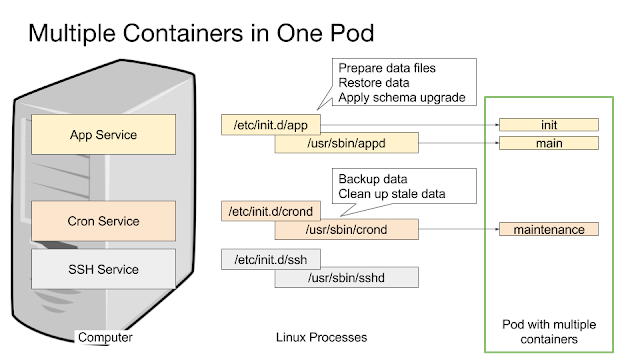
Update 23.04.2018: Added demo and link to conference talk video/slides at the end of this article Kubernetes is a great way to run applications because it allows us to manage single Linux processes with a real cluster manager. A computer with multiple services is typically implemented as a pod with multiple containers  sharing communication and storage : Ideally every container runs only a single process. On Linux, most applications have three phases with two different programs or scripts: The initialization  phase, typically an init script or a systemd unit file. The run  phase, typically a binary or a script that runs a daemon. The maintenance  phase, typically a script run as a CRON job. While it is possible to put the initialization phase into a Docker container as part of the ENTRYPOINT script, that approach gives much less control over the entire process and makes it impossible to use different security contexts for each phase, e.g. to prevent ...
Like this content? You could send me something from my Amazon Wishlist. Need commercial support? Contact me for Consulting Services.